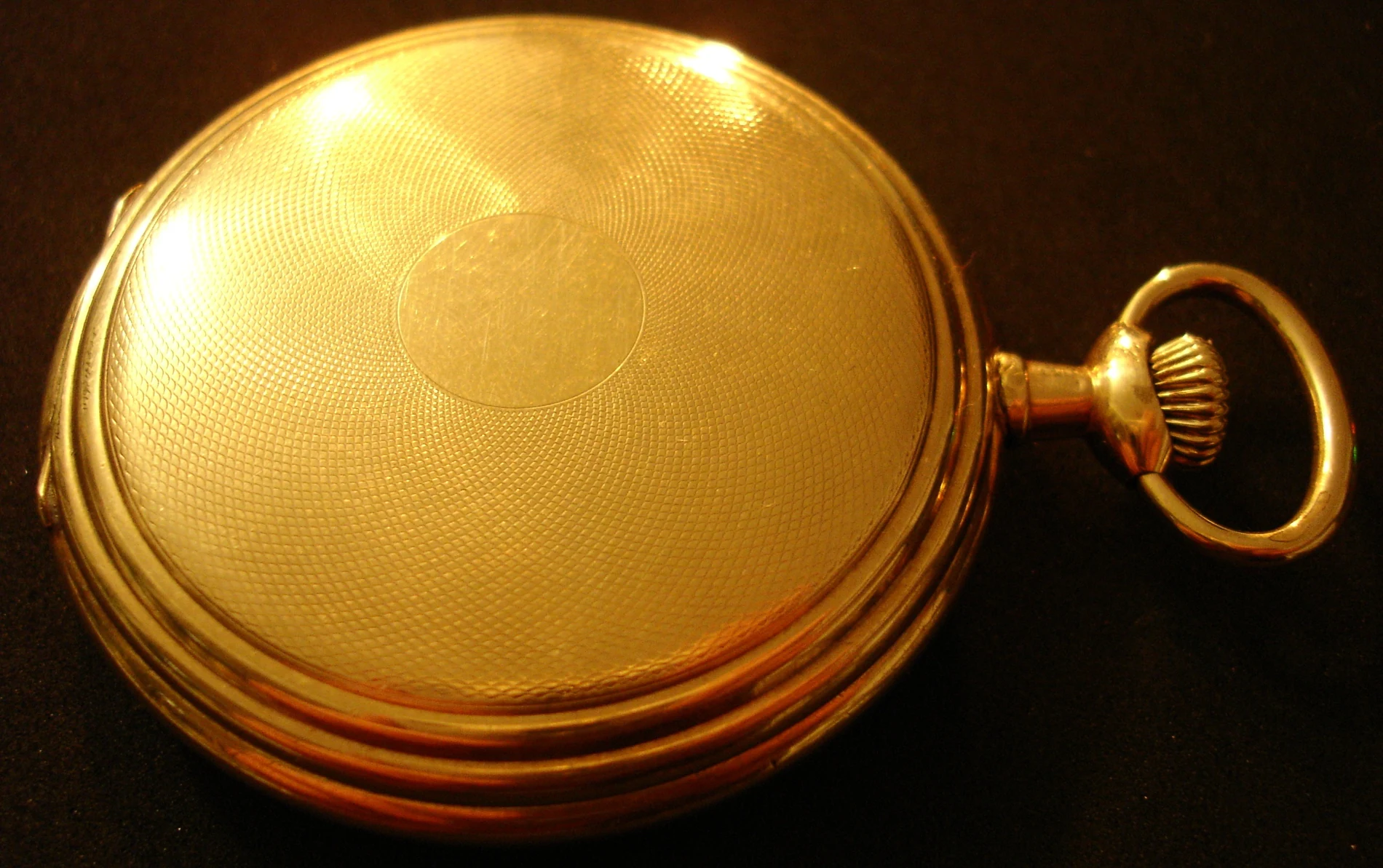
Before a wristwatch became something most people carry without much thought, a watch case was often the most decorated object a person owned that also did something useful. Pocket watches in particular were worn close to the body and taken out and opened dozens of times a day. They gave jewelers and case makers a small, valuable surface that was looked at constantly, and a surprising amount of skilled hand and machine work went into making that surface worth looking at.
Engine-Turning and Guilloché
Engine-turning is a mechanical rather than freehand method of cutting a repeating pattern into a metal surface, produced on a rose engine lathe or a straight-line engine, machines that guide a stationary cutting tool along a precisely controlled, repeating path while the workpiece itself rotates or moves beneath it. The resulting pattern is known as guilloché. It appears across a wide range of watch cases and dials in forms such as wave patterns, basket-weave grids, or radiating sunburst designs from a dial's center, and depends for its effect on absolute mechanical regularity: the pattern reads as fine and precise specifically because every repeat is identical, something a human hand working freehand cannot reliably reproduce across a whole dial or case back. The watchmaker Abraham-Louis Breguet is widely credited within horology with popularizing engine-turned guilloché dials in the late eighteenth century, both for their appearance and because a textured dial scatters light in a way that makes a watch's hands easier to read, a functional benefit layered onto a decorative one.
Hand Engraving
Hand engraving works by an entirely different logic: an engraver cuts a design freehand directly into the metal, using small hardened-steel tools called gravers, pushed or struck through the surface to remove material along a planned line. Scrollwork, foliate patterns, monogram medallions and pictorial scenes on watch case backs and covers were frequently cut this way. Bright-cut engraving is a technique where the graver's cut is angled to leave a polished, light-catching facet rather than a flat-bottomed groove. It was especially common on nineteenth- century watch cases because of how sharply it catches and throws light compared with a plainer incised line. Unlike engine-turning, no two hand-engraved pieces are ever mechanically identical, even when cut by the same engraver working from a similar pattern, which is part of what collectors and horologists look for when assessing the quality and hand of a specific piece of case work.
Case Artistry Beyond the Surface Cut
Engraving is only one layer of what makes an antique watch case a worked object rather than a plain container. Chasing is a related technique that pushes and shapes metal from the front surface using blunt punches rather than cutting tools. It raises low relief without removing any material, and repoussé does the same work from the reverse side, hammering a design up from behind so it stands proud of the surface when viewed from the front. Enameling fuses powdered colored glass onto a metal surface at high heat, sometimes into cells formed by thin metal wire in the cloisonné technique, and it added color to case backs and covers in a way neither engraving nor chasing alone could achieve. A single fine antique case sometimes combines two or three of these techniques on the same surface, an engine-turned ground beneath a hand-engraved monogram for instance. That is part of why case artistry gets assessed as its own specialized subject within watch collecting rather than treated as a minor detail beside the movement inside.
Case Artistry Versus Movement Finishing
Everything described so far concerns the case, the outer shell a wearer actually sees and touches. It is worth keeping that separate from a related but different tradition of decoration applied to the movement inside. Côtes de Genève is the parallel wavy stripes finished across a movement's bridges and plates. Perlage is the overlapping circular graining often applied to a movement's mainplate. Both serve a partly practical purpose alongside a decorative one, since a textured finish hides fine machining marks and helps trap loose dust. Case engraving and movement finishing both reward close looking, and a fine antique watch frequently carries both, but they are produced by different craftspeople working on different parts of the object, and neither substitutes for the other when assessing how much genuine hand or machine artistry a particular watch actually carries.
How Wear Changes Engraved Work Over Time
Engraved and engine-turned surfaces are not permanent in the way the underlying metal is. Repeated polishing is the kind a case accumulates over decades of ordinary handling and the occasional trip to a jeweler for a routine cleaning. It removes a small amount of metal from the surface each time, and a shallow engine-turned pattern can soften and eventually disappear entirely under that cumulative wear long before the case itself shows any structural damage. Deeper hand engraving is cut with more metal removed at the outset, and it generally survives longer under the same treatment, though a case that has been polished aggressively and repeatedly can still lose crisp definition in even a deep, confidently cut design. This is one of the reasons restorers and horologists examine engraved case work under magnification before doing anything to it: a pattern that looks intact at arm's length can be close to the point where one more polish erases it for good, and unlike a coin's surface, a watch case's engraving cannot be restruck once it has worn away.
A Craft Parallel to Coin Engraving
The core skill behind hand-engraved case work is cutting a controlled, deliberate design directly into hardened or semi-hardened metal with a graver. That skill is close kin to the skill behind hand-cut coin dies, and for much of history the two crafts drew from overlapping training and in some workshops the same engravers. Both demand the same combination of a sculptor's sense of form and a metalworker's precision, and both are unforgiving of a wrong cut in a way that painting or drawing is not: metal removed cannot be put back. How a coin design is engraved works through that parallel craft from the coin side, covering the reducing lathe, hubbing and the named engravers credited on familiar coin designs. A well-cut watch case belongs in that same conversation, elsewhere on Jewelry & Watches: not incidental decoration on top of a working mechanism, but skilled, deliberate cutting judged by much the same eye a critic brings to any other engraved or relief-worked metal object.