Every coin design begins somewhere other than metal. Before a single die is cut, a mint's engraver or an outside artist works up the design as a drawing and then, traditionally, as a sculpted relief model that is often several inches across, large enough to work the fine detail of a portrait or an emblem at a comfortable scale before anyone has to worry about shrinking it down to coin size. Most of the actual artistic decisions get made on that model rather than on the coin itself.
From a Large Model to a Small Die
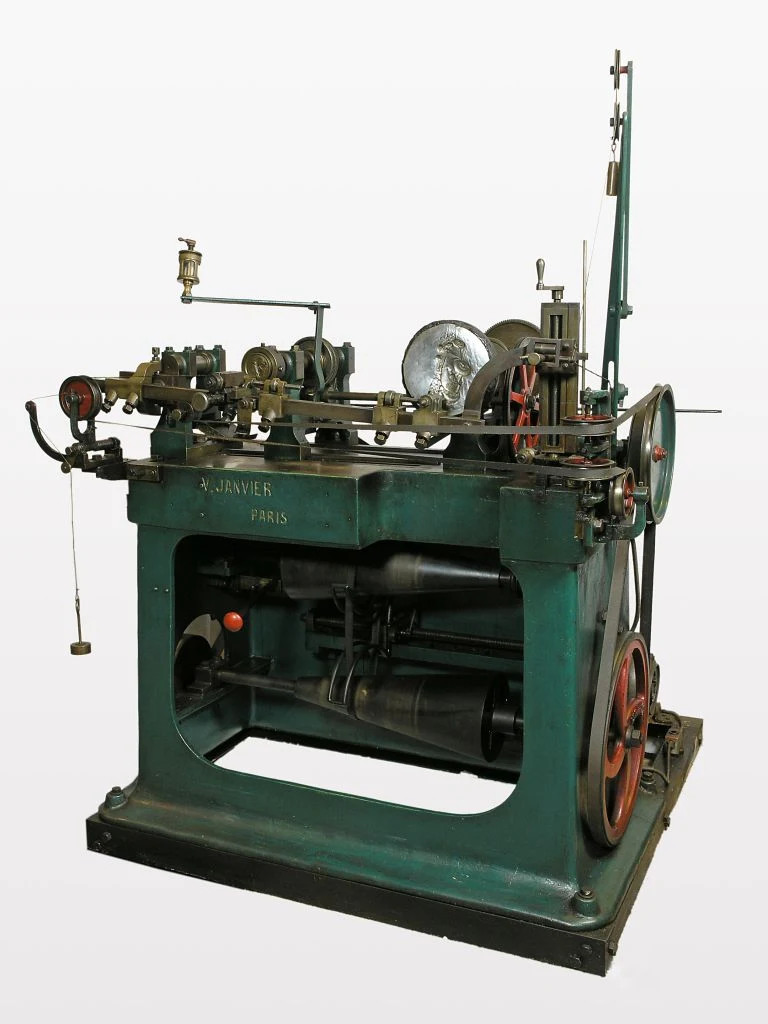
Getting a design from a large sculpted model down to the size of an actual coin while keeping every detail proportionally correct was for a long time the hardest technical problem in the whole process. The solution that dominated coin and medal production for well over a century is the reducing lathe, a machine that traces a stylus across the large model while a connected cutting tool reproduces the same path at a smaller scale onto a piece of steel. The French engineer Victor Janvier refined it significantly in the early twentieth century. The mechanical linkage between the tracing stylus and the cutting tool is what let engravers shrink a design reliably and repeatably instead of trying to hand-cut a miniature version from scratch and hope the proportions matched.
What the reducing lathe produces is not yet a die that can strike a coin. It produces a hub, a piece of steel carrying the design in relief, the same orientation the finished coin will show. That hub is hardened and then pressed into a softer steel blank under enormous force, a process called hubbing, which transfers the design onto the die itself in reverse, as an incuse image. The die is what actually strikes coins, not the hub, and a single hub can be used to produce many working dies over a mint's production run, which is why coins struck years apart from dies made off the same hub can still share identical design details down to fine points that a hand-engraver could never reproduce exactly twice.
Hand Engraving Before the Reducing Lathe
Before the reducing lathe became standard equipment, engravers cut dies directly and entirely by hand, working at or close to the coin's actual finished size using small chisels, gravers and punches. This method demanded an unusual combination of skills: an engraver needed a sculptor's sense of form to model a convincing portrait or figure in relief, and a metalworker's precision to cut that form correctly into hardened steel in reverse, without the benefit of any mechanical reduction to correct small errors along the way. Punches carrying standardized elements sped the work considerably, whether those elements were letters, numerals or a recurring decorative device. They also explain why certain design elements repeat with mechanical consistency across otherwise hand-cut early coinage: the punch produced that particular mark every time, not the engraver's freehand.
Named Engravers Behind Familiar Designs
Coin design is one of the few areas of applied art where the credited artist behind a widely circulated, everyday object is often a matter of public record rather than a mystery. Victor David Brenner designed the portrait of Abraham Lincoln that has appeared on the United States one-cent coin since 1909, and his initials appear in small letters on the design itself, a standard practice for crediting a coin's designer directly on the coin. Augustus Saint-Gaudens was already an established sculptor when he designed the 1907 twenty-dollar gold piece commissioned under President Theodore Roosevelt, a design widely regarded within numismatics as one of the most artistically ambitious coins the United States Mint ever struck, precisely because its high relief pushed hard against the practical limits of what a coining press could strike cleanly. Adolph Weinman designed both the Walking Liberty half dollar and the so-called Mercury dime, two designs from the same year that remain among the most reproduced coin images in American numismatics decades after both series ended. None of these are obscure attributions; they are documented, checkable facts about who actually made a design that continues to circulate or get reissued today.
Modern Engraving: From Steel Tools to Digital Files
Contemporary mints have largely replaced the mechanical reducing lathe with digital sculpting and computer-controlled cutting. A designer today can model a coin's relief on a computer, adjusting depth and detail directly in software before any physical model exists at all, and a computer-numerically-controlled engraving machine cuts the resulting file directly into a die blank or a master hub with a precision that mechanical reduction could approach but rarely match. This has not eliminated the artist's role in the process; it has moved the same design decisions into a different tool: how a portrait's relief should read at a small scale, how a design should balance against its surrounding field. The underlying craft judgment is the same judgment a hand-engraver exercised with a graver two centuries earlier, and it is still what separates a design that strikes up cleanly and reads well in the hand from one that does not.
Engine-turning and hand-engraving on precious-metal objects outside coinage follow a closely related logic, cutting a design directly into a hardened surface with tools built for exactly that purpose, and the artistry of antique engraved watches covers that parallel craft in detail, from machine-guided engine-turned patterns to fully hand-cut casework. Readers who want the finished-design side of this same subject rather than the manufacturing process can find it inthis site's Coins & Currency coverage, where a coin's design is treated on its own artistic terms once it has left the die shop and entered circulation.