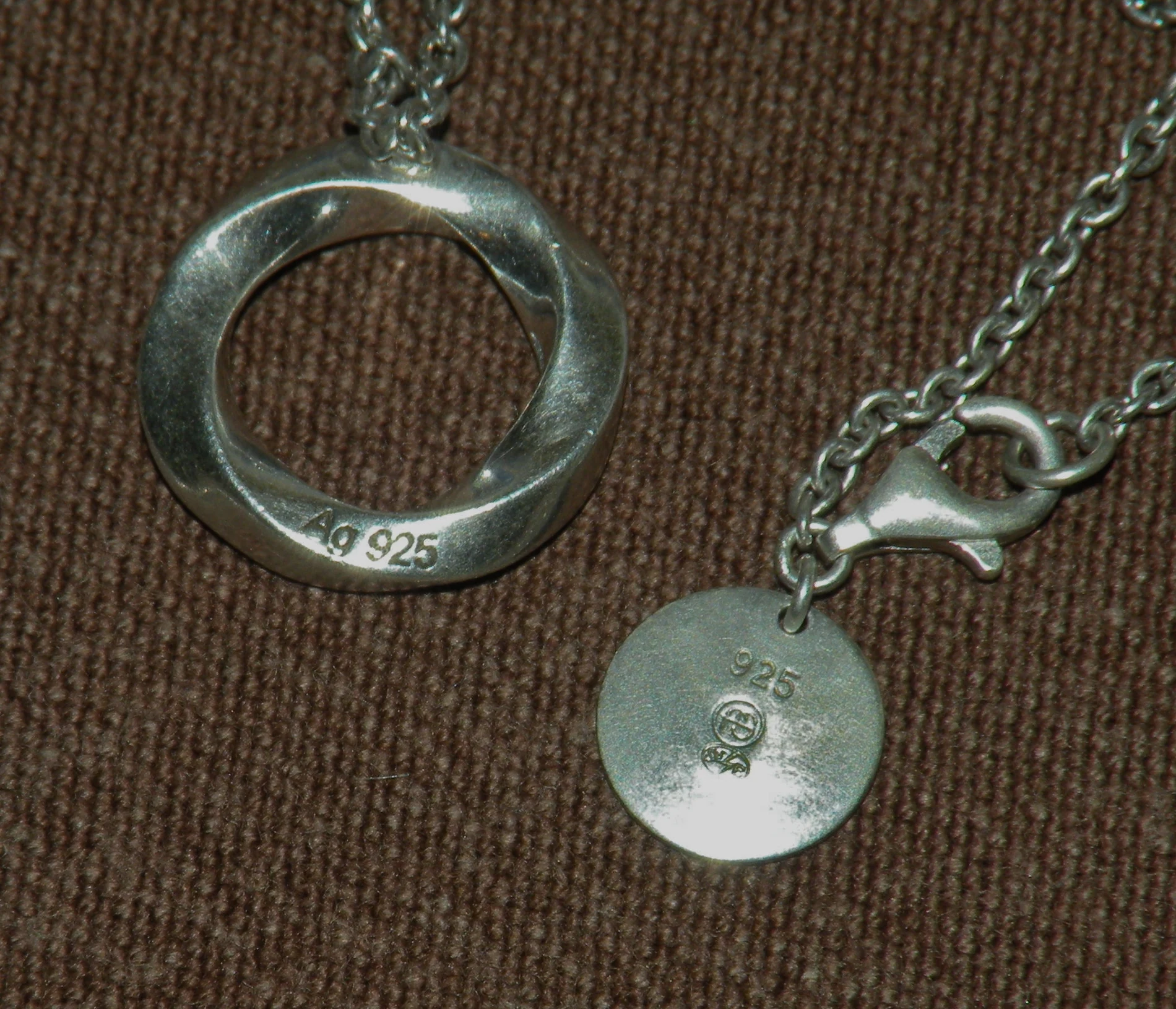
A hallmark on a ring, a bracelet or a watch case is often the first and only piece of physical evidence a piece carries about what it is actually made of. Finding it usually takes little more than a loupe and good light. Understanding what it actually proves takes a bit more care, and understanding what it does not prove matters just as much, because a metal-content mark and a claim about the piece's authenticity, age or maker are three separate questions that a single small stamp cannot answer all at once.
Gold Marks: Karat and Fineness
Gold jewelry is marked one of two ways, depending on where and when it was made. Karat marking is the system most familiar in the United States. It states purity as parts out of twenty-four: 24K is pure gold, 18K is eighteen parts gold to six parts other metal by weight, 14K and 10K step down further, each figure a legally defined minimum a manufacturer is required to meet. Decimal fineness marking is more common on European and internationally made pieces. It states the same underlying purity as parts per thousand instead: 999 for pure gold, 750 for eighteen-karat equivalent, 585 for fourteen-karat equivalent, and 417 for ten-karat equivalent. The two systems describe identical alloys; a piece stamped 750 and a piece stamped 18K carry the same gold content, just expressed in a different convention.
Whether that stamped number was independently verified depends entirely on where the piece was made. The United Kingdom is chief among the countries that require a compulsory assay system: an independent office tests the metal and strikes its own confirming mark before a piece can legally be sold as gold of a stated fineness. The United States has never had an equivalent compulsory system: a manufacturer stamps its own purity claim, and federal law makes that claim enforceable after the fact rather than verified in advance by an outside body. Both systems produce a legitimate mark, but only one of them means a third party actually checked the metal before the stamp went on.
Silver and Platinum Marks
Sterling silver jewelry is almost always marked 925 for the 92.5 percent silver content the sterling standard requires, sometimes alongside the word "sterling" spelled out. Continental European silver has historically used 800 as a common standard. That is a lower silver content than sterling, which is why a piece marked 800 is not lower quality craftsmanship, only a different and equally legitimate national standard. Platinum is marked by its own fineness numbers, most commonly 900 or 950 parts per thousand, which sometimes appear alongside "PLAT" or "PT." Because platinum resists corrosion and wear differently than gold or silver, its marking conventions developed somewhat separately and later, mostly across the twentieth century as platinum jewelry itself became more widespread.
Formal Hallmark Systems and Assay Marks
Where a formal assay system exists, a full hallmark carries more than a fineness number alone. British hallmarks on gold, silver and platinum typically combine a sponsor's mark identifying the maker or the party that submitted the piece for testing, a fineness mark stating the metal content, an assay office mark identifying which office tested the piece and historically shown as a symbol specific to that office, and a date letter that pins a piece to a specific year with real confidence. The date letter is drawn from a repeating sequence tied to a fixed run of years and rendered in a distinct typeface and shield shape for each cycle. A British-hallmarked piece gets its documented history from all of those elements read together, not from the fineness number on its own.
Maker's Marks and Retailer's Marks
Alongside any purity mark, many pieces carry a second stamp identifying who made the piece or who sold it, and those are not automatically the same party. A maker's mark identifies the workshop or manufacturer that physically produced the piece. A retailer's mark identifies the store that sold it under its own name, which historically was very often a different business from the one that actually fabricated the item. Well-known jewelry and watch retailers have at different points in their history both produced pieces in their own workshops and sold pieces made under contract by outside manufacturers, long-established houses such as Tiffany & Co. and Cartier among them. Only careful research into a specific mark can settle which situation applies to a given piece, and an assumption based on the name alone cannot.
What a Hallmark Does Not Certify
This is the distinction most worth carrying away from all of the above: a hallmark certifies metal content, and where a formal assay system applies, it certifies that an independent office tested that content at a specific place and time. It does not certify that a gemstone set into the piece is natural rather than synthetic or treated. It does not certify that the piece has not been altered since it was made through a resized ring shank, a replaced clasp, or a re-set stone. And it does not certify the piece's full attribution to a specific designer beyond whatever the maker's or retailer's mark itself states. A hallmark is real, checkable evidence about one specific fact: the metal. Treating it as proof of anything beyond that fact is the most common misunderstanding people bring to reading one.
The same maker's-mark-versus-retailer's-mark distinction runs through reading maker's marks and hallmarks on antiques, worked through there for silver, ceramics and glass rather than gold, silver and platinum jewelry specifically. The rest of Jewelry & Watches builds on the same starting point established here: read every mark a piece carries, identify which system it belongs to, and let that reading inform a closer look at the piece itself rather than substitute for one.