A mark on an antique is a small thing asked to do a lot of work: prove who made an object, date it within a range of years, and sometimes separate the actual manufacturer from the store that sold it under its own name. Finding one is often the easy part. Reading it correctly and knowing what it can and cannot prove on its own takes a bit more care, and the method changes depending on whether the object in hand is silver, ceramic, or glass.
Where Marks Actually Turn Up
Silver is the most consistently marked of the three. Flatware carries its marks on the back of the handle, usually near the point where it would rest against a table setting, while hollowware such as teapots, bowls and candlesticks is typically marked on the underside or base, struck into the metal itself rather than applied afterward. Ceramics hide their marks in a less uniform spot: most factory marks sit on the underside of a plate or the base of a vessel, but whether the mark was impressed into the clay before firing, printed in a stable ink under the glaze, or hand-painted over the finished glaze changes both how it looks and how much wear it can survive. Glass is the hardest of the three to check reliably, because a maker's signature is frequently etched or acid-stamped into the foot or pontil area, a mark thin enough that it disappears entirely if that area is ever reground to remove a chip.
A raking light is held at a low angle across the surface rather than straight on. It brings out a worn or shallow mark that direct overhead light tends to wash out completely. A jeweler's loupe or a simple magnifying glass helps with any mark small enough to blur at reading distance, which describes most hallmarks and a fair number of factory backstamps.
Silver Hallmark Systems
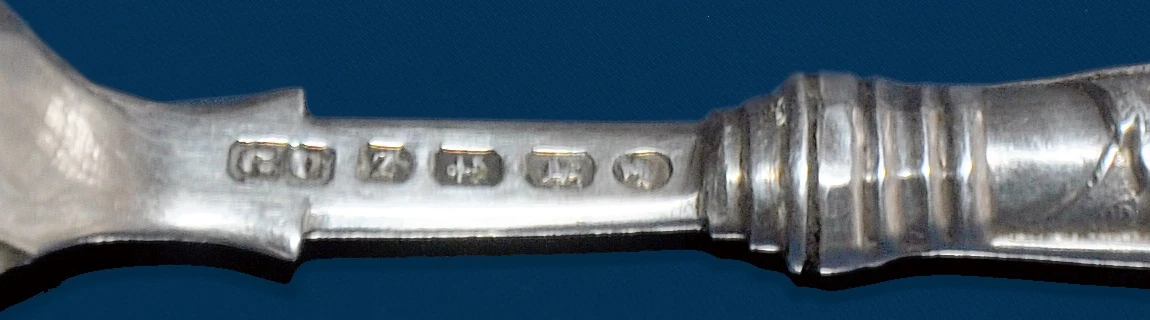
British silver carries the most formal system in wide circulation: a set of struck symbols applied by an independent assay office rather than by the maker, historically including a town mark identifying which office tested the piece, a standard mark such as a lion passant for sterling purity, a date letter that cycles through the alphabet on a fixed schedule, and the maker's own registered mark, usually initials in a shaped punch. What actually dates and verifies a British piece with confidence is reading all four together, not the maker's initials on their own.
American silver never developed an equivalent compulsory assay system, so the standard of proof is different by design. A manufacturer stamped its own purity claim directly onto the piece alongside its own maker's mark. That claim was most often the word "sterling" or the number 925, and no outside body verified it the way a British assay office did. Earlier American silver was often struck "coin" instead, before sterling became the standard mark in the 1860s. That older mark reflected an alloy closer to the purity of contemporary coinage rather than the higher standard sterling requires. Both marks name a real, checkable standard; neither one was independently tested the way a British hallmark was.
Marks on Ceramics
A ceramic backstamp's permanence depends entirely on how it was applied. A mark impressed into the clay body before firing becomes part of the object itself and survives as long as the piece does, and that method is common on stoneware and some porcelain. A mark printed in ceramic ink and then covered by the glaze during firing is nearly as durable, since the glaze protects it from surface wear. A mark painted on top of the finished glaze without a further firing to fuse it in place is the least reliable of the three: it can fade, rub off with repeated handling, or in rare cases be added after the fact to a piece that never carried it originally.
Some of the best-known marking systems build dating directly into the stamp. Wedgwood's impressed marks, for instance, have used letter and number codes tied to specific production years across parts of the company's history, which is why a Wedgwood mark can sometimes narrow a piece's date to within a few years rather than only confirming the factory. Meissen's crossed swords mark, by contrast, has stayed visually similar for centuries, which is exactly why it has also been one of the most frequently imitated ceramic marks in existence, and why the mark alone is treated as a starting point rather than final proof by anyone experienced with the factory's output.
Marks on Glass
Signed art glass is a smaller and more fragile category of mark than either silver or ceramics. Tiffany Studios etched signatures such as "L.C.T." into the pontil area of favrile glass pieces, and Steuben used an acid-stamped script signature on much of its output, though not all of it. Both marks sit in the same vulnerable spot: the foot or base, exactly where a chip is most likely to occur and exactly where a repair shop would grind the glass down to remove that chip. A reground, unsigned foot on a piece that is otherwise stylistically consistent with a known maker is a common and specific problem in glass collecting, one that silver and ceramics rarely face in the same way.
Maker's Mark Versus Retailer's Mark
The distinction that trips up the most people is not about reading a mark correctly but about knowing whose mark it actually is. A maker's mark identifies the workshop or factory that physically produced the object. A retailer's mark identifies the store that sold it, which is not always the same party at all. Tiffany & Co. is the clearest example: its own silver was largely produced in Tiffany's own workshops and carries a maker's mark that genuinely reflects who made it, but a great deal of porcelain sold under the Tiffany name in the nineteenth century was manufactured by outside factories and simply retailed, marked and boxed by Tiffany. Some of those factories were well-known French houses. Both marks are legitimate and both are worth recording, but they answer different questions: one names who actually shaped and fired or cast the object, the other names who stood behind the sale.
That same distinction runs through precious-metal jewelry and watches, where a retailer's name engraved inside a ring or stamped on a case back is just as often a seller's mark as it is proof of manufacture, and how to read jewelry hallmarks works through that overlap in more detail for pieces made in gold and platinum rather than silver, ceramic or glass. Back in Antiques more broadly, the habit that serves any collector best is the same one: find the mark, identify which of these systems it belongs to, and treat it as one piece of evidence rather than the whole answer.