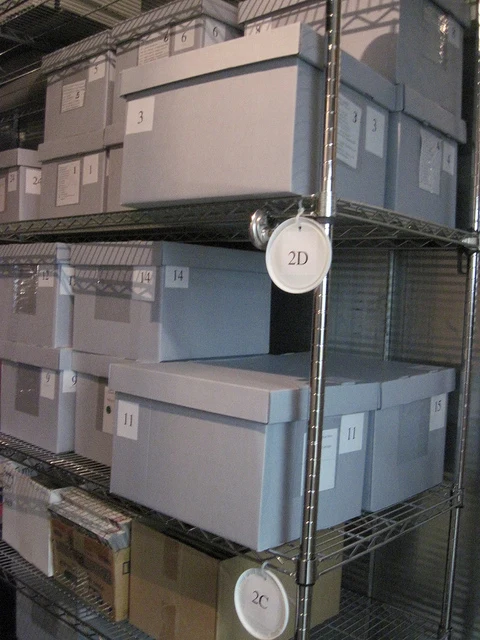
Most damage to a stored collection is not sudden. It builds slowly, from humidity, light or an unsuitable container working on an object for years before anyone notices, and by the time it is visible it is usually too late to reverse. Coins, paintings, paper, textiles, silver and jewelry each fail in their own way under poor storage, and each needs its own specific fix rather than a single general rule applied to all of them at once.
Coins: Holders and Humidity
A coin's biggest storage enemy is trapped moisture, and its second biggest enemy is often the holder meant to protect it. Older flexible coin holders are sometimes called flips. They were commonly made from PVC, a plastic that breaks down slowly over years and releases a chemical residue that can etch a coin's surface, leaving a hazy or sticky green film that is difficult or impossible to remove without also damaging the coin underneath. Modern PVC-free holders made from either mylar or a hard inert plastic avoid that specific failure and are worth switching to if an older collection is still sitting in flexible vinyl flips. Humidity is the other half of the problem: a damp basement or an uninsulated garage accelerates toning and corrosion on copper and silver coins in particular, so a stable interior room with moderate humidity protects a coin collection far better than a dry-looking closet in an uncontrolled part of a house. A silica gel packet inside the storage box helps further still.
Paper and Textiles: Light Damage That Cannot Be Undone
Paper and textiles share the same core vulnerability: ultraviolet light breaks down the fibers that hold them together, fading ink and dye and making the material itself brittle in a way no later treatment can fully reverse. A document, a print, an old photograph or a piece of vintage needlework will show that damage eventually even if it looks fine at first glance, whether it was left on display in direct sunlight or simply kept for years under strong indoor light. Acid-free folders, sleeves and boxes matter almost as much as light control, since ordinary paper and cardboard are acidic enough to gradually stain and weaken whatever they touch over long storage. Framed paper pieces benefit from UV-filtering glazing, and anything not currently on display is better kept flat or rolled in an acid-free container away from direct light than left loose in an open space.
Paintings and Canvas: Temperature and Humidity Swings
A painting on canvas expands and contracts slightly with every swing in temperature and humidity, and repeated swings over years are what actually cause cracking, cupping and paint loss, more than any single event usually does. An exterior wall that runs cold in winter and hot in summer, a spot directly above a heating vent, and a wall that catches hours of direct sun each day are the three most common culprits in an ordinary home, since each one puts a painting through a daily or seasonal swing that a more stable interior wall does not. Keeping a painting on an interior wall and away from vents and direct sun does more to protect it long term than any cleaning or restoration ever could.
Silver: What Tarnish Actually Is
Tarnish forms when silver reacts with sulfur compounds present in ordinary household air, and some materials speed that reaction up considerably. Rubber bands, rubber-lined drawer liners and certain wool and felt fabrics all release sulfur compounds of their own, so silver stored touching any of them tarnishes noticeably faster than silver kept away from them. Anti-tarnish cloth and anti-tarnish storage bags work by absorbing those sulfur compounds before they reach the silver, which slows tarnish far more effectively than any cleaning schedule after the fact. Wrapping each piece individually rather than storing a set loose in a drawer or a box also helps, since pieces touching each other directly can transfer tarnish and scratch one another during ordinary handling.
Jewelry: Softer Gems Need Softer Storage
Jewelry storage carries its own version of the same lesson: different materials fail differently, and treating every piece the same way damages some of them. Diamonds and most hard gemstones tolerate being stored loosely without much risk to the stone itself, but organic materials commonly set alongside them do not. Pearls and opals both contain water bound into their structure and can dry out, craze, or develop fine surface cracks in an environment that is too warm or too dry, so a piece built around either material benefits from a stable, moderate humidity rather than the bone-dry conditions that suit paper or coins. Softer stones and metals also scratch far more easily than most collectors expect: storing pieces individually in soft pouches or lined compartments prevents a hard stone or a sharp prong from marking a softer piece, something that happens easily once pieces are simply left loose together in a single box or drawer.
The Household Habit That Covers All of It
Across every material above, the same handful of household choices does most of the protective work: a stable interior room rather than an attic, a basement or a garage, moderate humidity rather than either extreme, and distance from direct sunlight and heating or cooling vents. None of this requires a climate-controlled vault or specialized equipment. It requires picking the right room in an ordinary house and being consistent about keeping fragile material there rather than wherever happens to have empty shelf space.
Silver raises one storage question this article can only summarize: how to actually clean it once tarnish does appear without damaging the detail underneath. Antique silver collecting basics covers that specific question directly, alongside how to tell sterling from silverplate in the first place. The storage habits above apply just as directly to a coin collection, a set of paintings or a box of family papers as they do to silver, and keeping any of them in a stable room built for their own material is worth as much attention as anything covered in the rest of Collecting Guides.