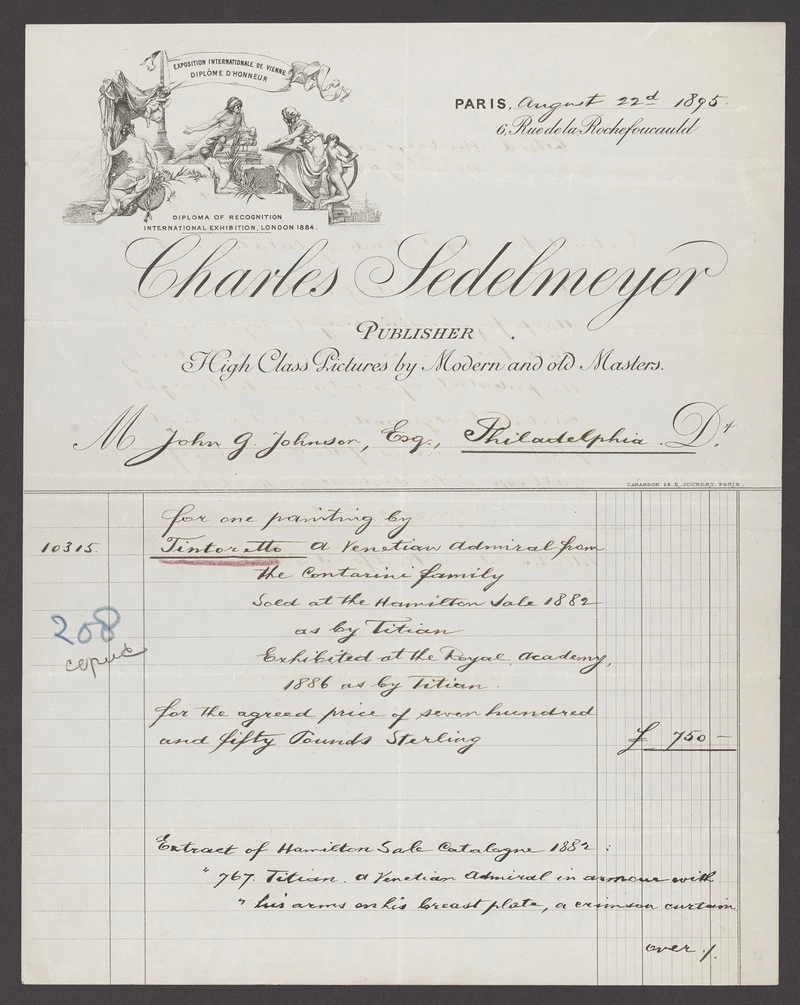
Provenance is the record of who has owned an object, where it has been, and how it moved from one owner to the next. Every collecting category on this site treats provenance as evidence rather than sentiment, and every category treats a strong record as something that measurably raises value rather than as a pleasant extra. What changes from one category to another is only the form that evidence takes: a gallery label means something different from a hallmark, which means something different from a hoard record, but all three are doing the same job.
The Same Underlying Test, Four Different Kinds of Paper
A useful provenance record is built from documents created for some other purpose at the time, which is exactly why they carry weight. Nobody filling out a receipt book, cataloguing an exhibition, or writing an insurance schedule decades ago was trying to prove anything about a future sale; they were just doing routine paperwork that happened to name an object. For a painting, that paperwork tends to look like gallery labels, exhibition catalog entries and auction house lot records. For an antique, it more often looks like a dated bill of sale, a household inventory taken for insurance, or a photograph of the piece in a family home decades before anyone thought to ask what it was worth. For a coin, provenance frequently means something closer to findspot and hoard association: where and how it was recovered, and whether it can be matched to a published hoard or an old numismatic sale catalog. For jewelry and watches, an original box, a maker's receipt, or an insurance appraisal from years before a sale often carries the same weight a gallery label carries for a painting. Different paper, same underlying test: was this written down by someone with no stake in a future claim about the object.
Family Memory Is a Lead, Not a Record
Every category faces the same gap between what a family remembers and what can actually be checked. A relative's confident account of where a ring, a coin album, or a painting came from is worth writing down and worth investigating further. On its own, it is not the kind of evidence a specialist can rely on, because memory shifts with retelling in ways a dated receipt or a printed catalog entry does not. The strongest provenance records combine both: a family's account pointing toward where to look, and a document from the time confirming that the account holds up.
How a Broken Chain Reads Differently Depending on the Object
A gap in a provenance record is common and is not automatically a warning sign in any of the four categories, but how much a given gap matters does depend somewhat on the object. Older paintings and antiques routinely spend decades in a single family's hands with nothing written down, simply because nobody expected a record would ever be needed, and a plausible unbroken story around that quiet stretch is normal rather than suspicious. Coins behave a little differently: a coin with no findspot or prior ownership record at all is common and not inherently troubling, since huge numbers of coins have always circulated anonymously, but a coin claimed to come from a specific documented hoard needs that specific claim to actually check out against the published hoard record, or the claim itself becomes the problem rather than the coin. What matters across every category is the same underlying question: does the record that does exist hold together internally, and is the earliest documented point plausible for an object of that supposed age and origin.
Why a Record Moves Price, Not Just Confidence
Provenance changes value for a fairly simple reason: it reduces the buyer's risk, and buyers pay for reduced risk in every category covered here. Two objects that look identical side by side do not command the same interest from a serious buyer if one carries a documented history and the other carries none, whether the objects in question are a painting, an antique, a coin or a piece of jewelry. The object with a record is a known quantity; the one without it is a bet the buyer has to price in themselves, and that discount shows up at sale whether the category is art, antiques, numismatics or jewelry. A strong record can also do the opposite job just as usefully: it can rule out a competing claim of theft, forced sale, or disputed ownership before a buyer ever has to ask the question, which matters most for older paintings and antiques but is not unique to either.
None of this makes provenance a substitute for authentication. A strong paper trail supports an attribution or a claimed origin; it does not replace a specialist's direct examination of the object itself. Provenance fraud is itself a well-documented problem across every collecting category: invented receipts and exaggerated ownership chains are the usual tools of a record built to deceive rather than to inform. Provenance and authenticity answer related but separate questions, and a serious buyer in any category checks both rather than treating a good paper trail as proof on its own.
What This Means for Something Sitting in a Drawer
The practical habit is the same regardless of category: gather whatever paperwork already exists around an object and keep that material physically or digitally attached to the object rather than filed away where it can drift apart from it over time, whether that means receipts, labels, old photographs, prior appraisals or correspondence that mentions it by name. A gap in the record is a question worth answering eventually, not a reason to assume the worst about something inherited or long-held. What provenance means for a painting works through exactly this principle for one category in detail, covering gallery labels, exhibition history and auction records specifically. Building a similar habit for photographs, storage and a wary eye toward reproductions is what the rest ofCollecting Guides takes up next, so that whatever paperwork a family gathers around an object stays intact alongside it for whoever looks at either one later.