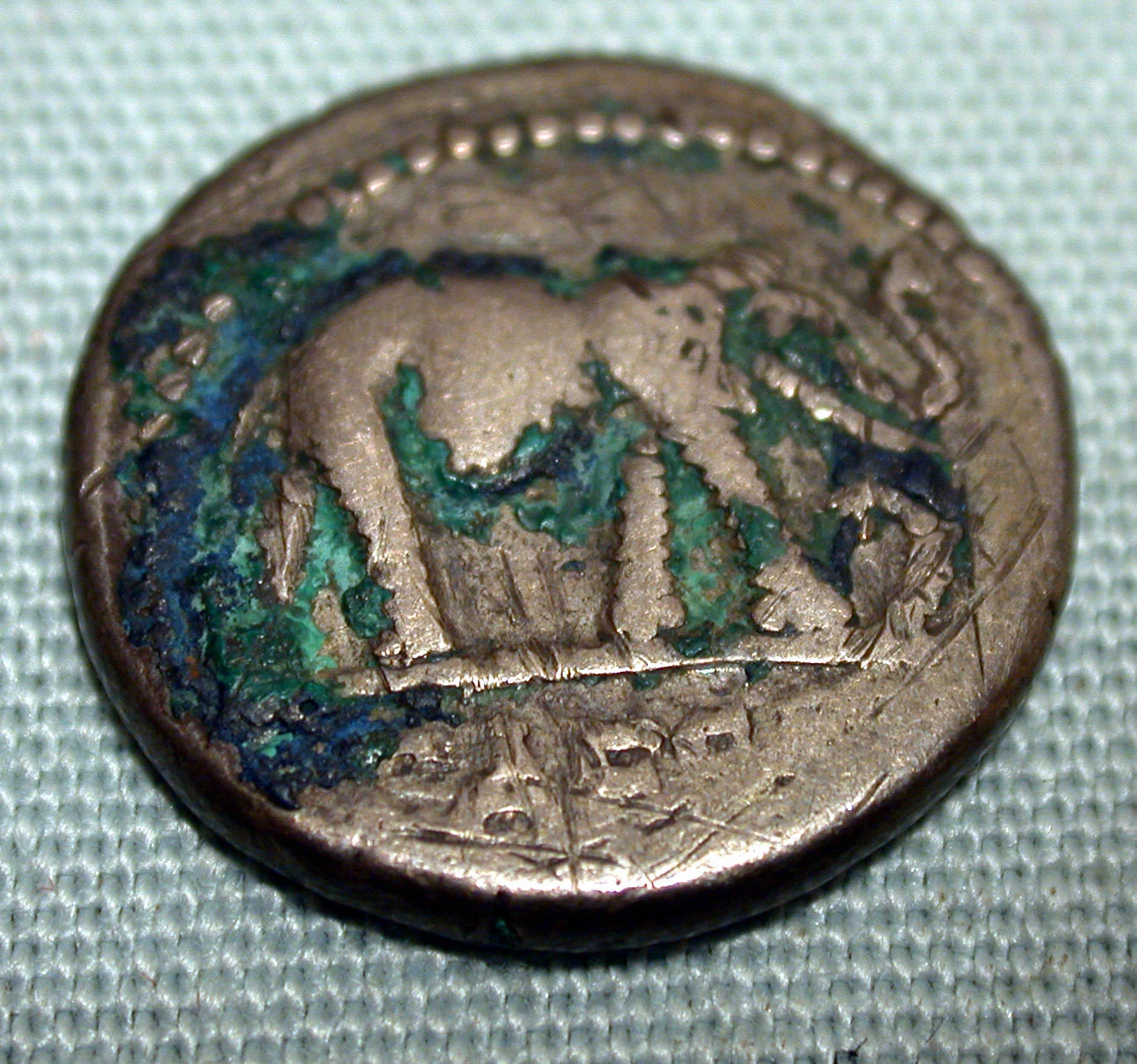
For much of the ancient world, a coin is not simply an old object; it is close to a primary document. Ancient states did not leave behind newspapers, censuses or press releases in any form a modern researcher would recognize, and for long stretches of history a ruler's portrait, titles, and civic or religious imagery struck onto a coin are among the most direct surviving evidence of who held power, what they claimed to represent, and how they wanted to be seen by the people who handled their money every day.
A Coin as a Dated, Located Historical Record
An ancient coin usually carries more built-in historical information than most other surviving artifacts of comparable size. A ruler's portrait and titles identify a reign, sometimes down to a specific regnal year recorded in the legend around the rim. A mint mark or a distinctive local design identifies where the coin was struck, since ancient mints frequently used design details specific to their own city or region rather than a single unified national design. Civic and religious imagery ties the coin to a particular place's own self-image, whether the design shows a city's patron deity, a local monument, or a symbol tied to a specific cult. That evidence supplements what later written histories claim about the place, and sometimes corrects them. Classical Athens is the clearest widely known example: its silver tetradrachms carried the owl of Athena and the goddess's own profile for roughly two centuries with only minor variation, a design so recognizable and so trusted in trade across the ancient Mediterranean that the coin type itself became a kind of civic brand, studied today through large standing reference catalogs like the Sylloge Nummorum Graecorum series that museums and numismatic societies maintain specifically to document ancient coin types systematically.
Hoards as Archaeological Evidence
A single ancient coin found without any record of where it came from still carries its design and inscription, but it loses most of its power as historical evidence. A hoard is a group of coins buried or otherwise concealed together and recovered as a unit with its findspot recorded. It is a different kind of evidence entirely, because the coins within it can usually be dated closely enough to establish roughly when the hoard was buried, and the mix of mints and rulers represented can show how currency actually circulated across a region rather than how a single mint intended it to. The Hoxne Hoard is a large hoard of late Roman gold and silver coins and objects discovered in Suffolk, England in 1992 and now held by the British Museum. It is a well-documented example of exactly this kind of evidence: the museum's own published collection record for the hoard lays out what was found, where, and what the coins within it establish about the period, precisely the kind of primary documentation that separates a checkable historical claim from an assumption about what an old coin probably means.
This is also why findspot and hoard association matter enormously to serious numismatic research and to museums, in a way that can seem overly cautious to a newcomer holding a single loose ancient coin with no such record attached. A coin separated from its findspot still has real value as an object and as a design, but it has permanently lost a layer of historical information that no amount of study of the coin alone can recover. Reputable collections and catalogs record findspot and hoard association wherever it is known, specifically because that information cannot be reconstructed after the fact. The American Numismatic Society's public database of accessioned coins is one such catalog.
Sculpture at a Scale No Larger Medium Attempts
Ancient coin design deserves to be read as sculpture in its own right, not merely as a historical record that happens to carry an image. Hellenistic-era coinage is a strong case in point. In particular, the tetradrachms issued in the name of Alexander the Great and continued by his successors carried portraiture in relief refined enough that specialists in ancient art routinely compare specific coin types to contemporary large-scale sculpture and gem-cutting from the same workshops and regions, treating die-engraving as one branch of the same sculptural tradition rather than a separate, lesser craft. The scale constraint that shapes all coin design is discussed at more length elsewhere in this section. It applied just as forcefully to an ancient engraver working with simple hand tools as it does to a modern engraver using precision machinery, which makes the artistic achievement of the best ancient dies more remarkable rather than less: the same compressed, shallow-relief problem, solved centuries earlier with far less sophisticated equipment.
Portraiture and Political Change on Roman Coinage
Roman coinage records a genuine political shift in a way that is unusually easy to date. For most of the Roman Republic, coins carried imagery of gods, mythological scenes, or ancestors of the moneyer overseeing that year's coinage, but not the living faces of sitting officials. Julius Caesar broke with that convention late in his life when the Roman Senate granted him the right to place his own portrait on Roman coinage, making him the first living Roman to appear on the state's own currency, a documented turning point that later Roman emperors followed as standard practice for the rest of the imperial period. Standard reference catalogs exist precisely because that portrait-and-legend record is detailed enough to track political change across several centuries, reign by reign and sometimes year by year. Roman Imperial Coinage is one such catalog: the multivolume academic series numismatists still use to identify and date individual imperial issues.
Reading an Ancient Coin as Both Record and Object
Treating an ancient coin seriously means holding both readings at once rather than choosing between them. As a historical record, its portrait, legend and mint attribution place it at a specific point in a specific place's history in a way few other surviving objects can match, and its findspot and hoard association do the same wherever those are known. As a piece of relief sculpture, it rewards the same close, comparative looking that a specialist in ancient bronzes or gem engraving would bring to contemporary work in other media. Ownership history and findspot function for an ancient coin much the way a documented chain of ownership functions for a painting, and what provenance means for a painting works through that same principle from the fine-art side: a well-documented history genuinely changes what an object can tell you, and what it is worth relies on a different, later question entirely.
The rest of this site's Coins & Currency coverage picks up that later question directly, including how collectible value and metal value diverge and what to do with a coin collection that has come into a family's hands without any of this documentation attached, but the starting point for an ancient coin specifically is always the two readings covered here: what it records, and how it was made.